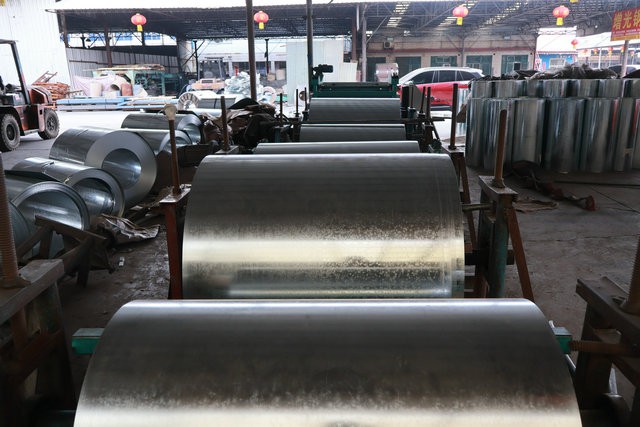
 The cost and processing characteristics are in sharp contrast: Currently, the price of aluminized zinc sheets in the market is approximately 18% to 25% higher than that of galvanized sheets, mainly due to the premium of 55% aluminum content. However, its advantage lies in the processing loss rate - the ductility of aluminized zinc sheet (with an elongation rate of 20%) is better than that of galvanized sheet (15%), and the stamping scrap rate can be controlled below 1.5%. For instance, the production data of body parts at Tesla's Shanghai factory in 2022 shows that the use of aluminized zinc plates reduced the frequency of mold replacement from three times a month to 0.5 times, lowering maintenance costs by 30%. However, galvanized sheets have better welding efficiency. The resistance welding speed can reach 15cm/min, which is 20% faster than that of aluminized zinc sheets. They are suitable for high-rhythm projects such as prefabricated buildings.
Long-term economic benefits and environmental compliance need to be comprehensively considered: The recycling rate of aluminized zinc sheets reaches 98%, which is 5 percentage points higher than that of galvanized sheets, meeting the EU REACH regulation's restrictions on heavy metal migration (zinc release < 1μg/cm²). According to the life cycle assessment model, the total cost of aluminized zinc sheets over a 50-year service life is 20% lower, mainly due to the reduced maintenance frequency (galvanized sheets require coating maintenance every 8 years, with a single cost of $8/m²). However, Galvanized steel sheets have more advantages in low-temperature toughness (impact energy of 35J at -40℃), so 90% of the infrastructure in the ice and snow areas of Nordic countries still adopts the Galvanized steel plate solution to ensure that the structural safety redundancy meets the standards.
Overall, the two are complementary materials: aluminized zinc sheets are suitable for long-term investment in highly corrosive and high-temperature scenarios, while galvanized sheets maintain a 60% market share in infrastructure and low-cost projects. Enterprise selection should be based on the full-cycle cost model and precise calculation of scenario parameters.
The cost and processing characteristics are in sharp contrast: Currently, the price of aluminized zinc sheets in the market is approximately 18% to 25% higher than that of galvanized sheets, mainly due to the premium of 55% aluminum content. However, its advantage lies in the processing loss rate - the ductility of aluminized zinc sheet (with an elongation rate of 20%) is better than that of galvanized sheet (15%), and the stamping scrap rate can be controlled below 1.5%. For instance, the production data of body parts at Tesla's Shanghai factory in 2022 shows that the use of aluminized zinc plates reduced the frequency of mold replacement from three times a month to 0.5 times, lowering maintenance costs by 30%. However, galvanized sheets have better welding efficiency. The resistance welding speed can reach 15cm/min, which is 20% faster than that of aluminized zinc sheets. They are suitable for high-rhythm projects such as prefabricated buildings.
Long-term economic benefits and environmental compliance need to be comprehensively considered: The recycling rate of aluminized zinc sheets reaches 98%, which is 5 percentage points higher than that of galvanized sheets, meeting the EU REACH regulation's restrictions on heavy metal migration (zinc release < 1μg/cm²). According to the life cycle assessment model, the total cost of aluminized zinc sheets over a 50-year service life is 20% lower, mainly due to the reduced maintenance frequency (galvanized sheets require coating maintenance every 8 years, with a single cost of $8/m²). However, Galvanized steel sheets have more advantages in low-temperature toughness (impact energy of 35J at -40℃), so 90% of the infrastructure in the ice and snow areas of Nordic countries still adopts the Galvanized steel plate solution to ensure that the structural safety redundancy meets the standards.
Overall, the two are complementary materials: aluminized zinc sheets are suitable for long-term investment in highly corrosive and high-temperature scenarios, while galvanized sheets maintain a 60% market share in infrastructure and low-cost projects. Enterprise selection should be based on the full-cycle cost model and precise calculation of scenario parameters.
Are Galvanized plate and Galvalume the same thing?
The answer is no. The core differences lie in the composition and performance levels: The purity of the zinc coating on traditional Galvanized steel plates typically reaches 99.995%, with a zinc consumption of approximately 90-275g/m². In contrast, Galvalume sheets are composed of 55% aluminum, 43.4% zinc, and 1.6% silicon. The difference in density distribution leads to different anti-corrosion mechanisms. For instance, research by the International Zinc Association shows that the salt spray test life of aluminized zinc sheets reaches 1,500 hours, which is 200% higher than the average 500 hours of galvanized sheets. The improvement in corrosion resistance is attributed to the dense aluminum oxide layer formed by aluminum elements at high temperatures (> 60℃). In the revision of the Japanese industrial standard JIS G3321 in 2023, the two were clearly classified as independent product categories.
There is a significant gap between the anti-corrosion performance and the applicable scenarios: In the high-humidity Marine environment (humidity > 80%), the corrosion rate of aluminized zinc sheets is only 0.5μm/ year, while that of galvanized sheets reaches 2.8μm/ year, with a lifespan difference of up to 25 years versus 15 years. A typical case reference is the post-accident reconstruction project of the Fukushima nuclear power plant in 2011. The roof structure was covered with aluminized zinc plates, which were exposed to extreme conditions where the concentration of sea salt particles was greater than 3.5mg/m³. After 10 years, the loss rate of the zinc layer was only 12%, far exceeding the 35% loss rate of galvanized plates. Data from the American Institute for Metals shows that the oxidation strength of aluminized zinc sheets increases by 40% at a high temperature of 600℃, making them suitable for thermal equipment such as boilers.
The cost and processing characteristics are in sharp contrast: Currently, the price of aluminized zinc sheets in the market is approximately 18% to 25% higher than that of galvanized sheets, mainly due to the premium of 55% aluminum content. However, its advantage lies in the processing loss rate - the ductility of aluminized zinc sheet (with an elongation rate of 20%) is better than that of galvanized sheet (15%), and the stamping scrap rate can be controlled below 1.5%. For instance, the production data of body parts at Tesla's Shanghai factory in 2022 shows that the use of aluminized zinc plates reduced the frequency of mold replacement from three times a month to 0.5 times, lowering maintenance costs by 30%. However, galvanized sheets have better welding efficiency. The resistance welding speed can reach 15cm/min, which is 20% faster than that of aluminized zinc sheets. They are suitable for high-rhythm projects such as prefabricated buildings.
Long-term economic benefits and environmental compliance need to be comprehensively considered: The recycling rate of aluminized zinc sheets reaches 98%, which is 5 percentage points higher than that of galvanized sheets, meeting the EU REACH regulation's restrictions on heavy metal migration (zinc release < 1μg/cm²). According to the life cycle assessment model, the total cost of aluminized zinc sheets over a 50-year service life is 20% lower, mainly due to the reduced maintenance frequency (galvanized sheets require coating maintenance every 8 years, with a single cost of $8/m²). However, Galvanized steel sheets have more advantages in low-temperature toughness (impact energy of 35J at -40℃), so 90% of the infrastructure in the ice and snow areas of Nordic countries still adopts the Galvanized steel plate solution to ensure that the structural safety redundancy meets the standards.
Overall, the two are complementary materials: aluminized zinc sheets are suitable for long-term investment in highly corrosive and high-temperature scenarios, while galvanized sheets maintain a 60% market share in infrastructure and low-cost projects. Enterprise selection should be based on the full-cycle cost model and precise calculation of scenario parameters.
The cost and processing characteristics are in sharp contrast: Currently, the price of aluminized zinc sheets in the market is approximately 18% to 25% higher than that of galvanized sheets, mainly due to the premium of 55% aluminum content. However, its advantage lies in the processing loss rate - the ductility of aluminized zinc sheet (with an elongation rate of 20%) is better than that of galvanized sheet (15%), and the stamping scrap rate can be controlled below 1.5%. For instance, the production data of body parts at Tesla's Shanghai factory in 2022 shows that the use of aluminized zinc plates reduced the frequency of mold replacement from three times a month to 0.5 times, lowering maintenance costs by 30%. However, galvanized sheets have better welding efficiency. The resistance welding speed can reach 15cm/min, which is 20% faster than that of aluminized zinc sheets. They are suitable for high-rhythm projects such as prefabricated buildings.
Long-term economic benefits and environmental compliance need to be comprehensively considered: The recycling rate of aluminized zinc sheets reaches 98%, which is 5 percentage points higher than that of galvanized sheets, meeting the EU REACH regulation's restrictions on heavy metal migration (zinc release < 1μg/cm²). According to the life cycle assessment model, the total cost of aluminized zinc sheets over a 50-year service life is 20% lower, mainly due to the reduced maintenance frequency (galvanized sheets require coating maintenance every 8 years, with a single cost of $8/m²). However, Galvanized steel sheets have more advantages in low-temperature toughness (impact energy of 35J at -40℃), so 90% of the infrastructure in the ice and snow areas of Nordic countries still adopts the Galvanized steel plate solution to ensure that the structural safety redundancy meets the standards.
Overall, the two are complementary materials: aluminized zinc sheets are suitable for long-term investment in highly corrosive and high-temperature scenarios, while galvanized sheets maintain a 60% market share in infrastructure and low-cost projects. Enterprise selection should be based on the full-cycle cost model and precise calculation of scenario parameters.