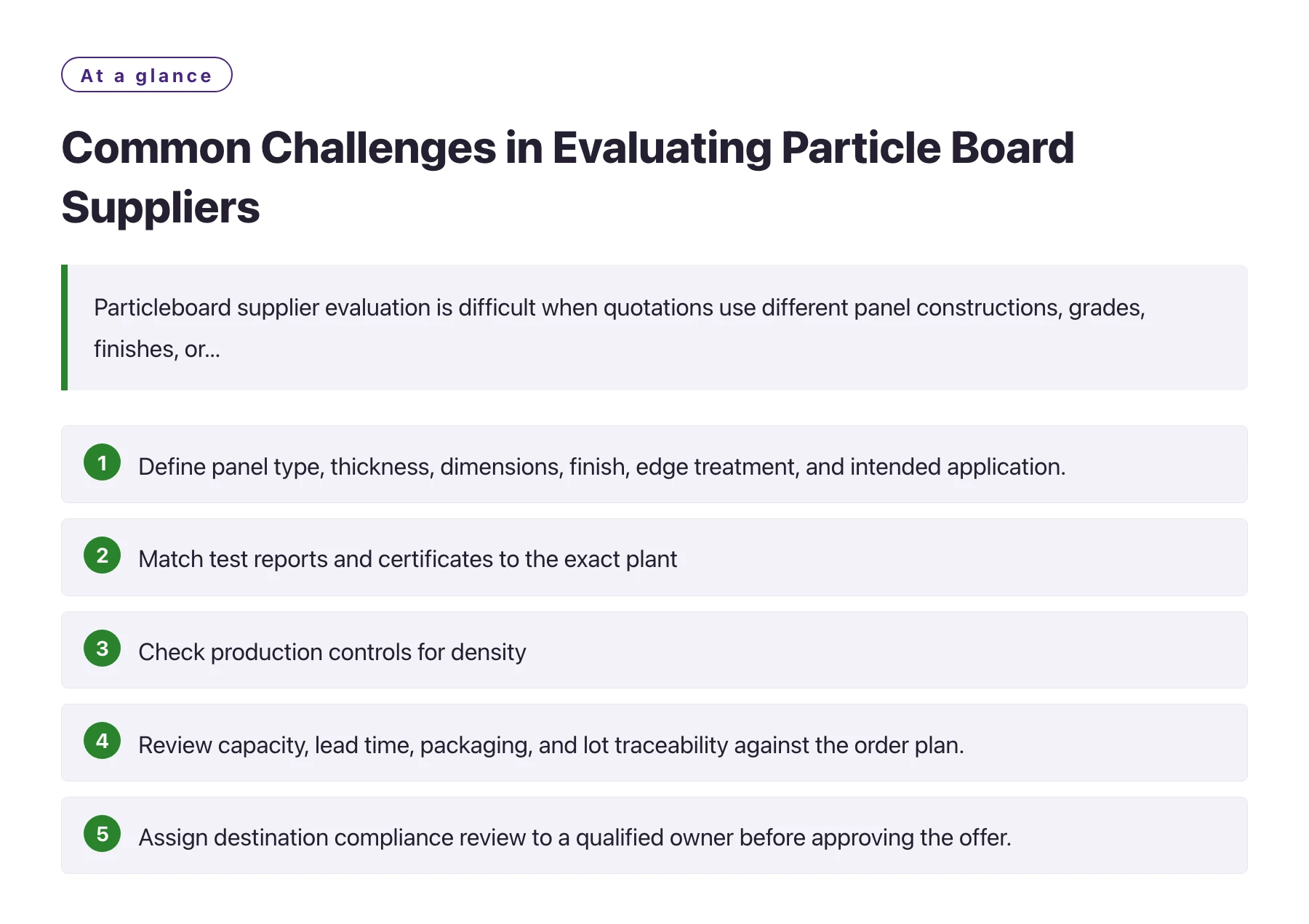
Particleboard supplier evaluation is difficult when quotations use different panel constructions, grades, finishes, or test evidence. Define thickness, dimensions, density or performance requirements, surface treatment, moisture conditions, emissions obligations, and intended use before comparing offers. Then assess factory capability, lot consistency, traceability, packaging, and change control. A low price has little meaning if the quoted board cannot be tied to the specified product and destination requirements.
Key takeaways
- Define panel type, thickness, dimensions, finish, edge treatment, and intended application.
- Match test reports and certificates to the exact plant, product, and production period.
- Check production controls for density, thickness, bonding, surface, and moisture variation.
- Review capacity, lead time, packaging, and lot traceability against the order plan.
- Assign destination compliance review to a qualified owner before approving the offer.
Use a supplier scorecard that separates product evidence from commercial and service claims.
1. Different quotes may describe different boards
Start with an unambiguous specification: particleboard or another panel type, thickness and tolerance, length and width, density range if required, face condition, lamination or veneer, edge treatment, intended use, and any machining. Clarify whether the board is raw, coated, pre-drilled, or supplied as a finished component. Buyers comparing only a nominal thickness and price can miss the construction details that affect processing and performance.
Ask suppliers to return a completed specification table and list every exception. If a supplier proposes a substitute core, resin, surface, or manufacturing site, treat it as a change that needs technical review. Keep brand names and “E0” or “low emission” sales terms separate from the actual test method, product scope, and destination requirement.
2. Test evidence may not match the offered product
Check the laboratory report’s product identity, factory, sample description, thickness, finish, test method, result, date, and issuing laboratory. Confirm that a report covers the same panel construction and relevant production site as the quotation. A test on a different thickness, resin, supplier, or finished assembly may not answer the buyer’s question. Ask for clarification when the scope is incomplete rather than assuming the result transfers to all products.
Destination market matters. For products sold, supplied, or imported in the United States, EPA’s TSCA Title VI formaldehyde rule covers particleboard and includes testing, labeling, recordkeeping, and import-certification provisions. Confirm whether a specific panel or finished product falls within scope and check current obligations with the importer’s compliance owner; other markets may apply different rules. [1]
3. Factory claims need process evidence
Ask how the plant controls incoming furnish, resin preparation, forming, pressing, sanding, thickness, density, and surface defects. Request records or an explanation appropriate to the product and risk. Ask which measurements are monitored per shift or batch, what limits trigger a stop, and how nonconforming panels are segregated. A supplier’s general quality certificate does not, by itself, prove that a specific product meets the buyer’s specification.
If the supplier is a trader, identify the actual production site and who controls the technical records. Confirm that the quoted factory will make the order and that subcontracting or site changes require prior approval. For a high-volume or high-consequence order, the buyer may need a site assessment or specialist review. Set the scope and access conditions before the order is placed.
4. Consistency can vary across a lot
Particleboard properties and appearance may vary by batch, thickness, surface, and process settings. Define how samples will be selected and what checks will be performed on production or finished goods. Depending on application, the technical owner may specify dimensional checks, surface inspection, edge quality, moisture-related measures, or performance tests. Use agreed methods and acceptance limits rather than inferring a panel’s suitability from a showroom sample.
Ask how production lots are identified and how retained samples or records are handled. For laminated or finished panels, determine whether the face material, adhesive, and substrate are controlled as one traceable assembly. Mark the approved sample with product code, revision, date, and supplier acknowledgment. If the first shipment establishes a reference, define how later repeat orders will be compared without treating normal process variation as an unapproved substitution.
5. Capacity and lead time may be overstated
Request evidence that the plant can produce the required sizes, finishes, and volume within the requested window. Ask about current production loading, raw-material constraints, minimum order quantities, tooling, line changeovers, and maintenance or holiday shutdowns. Separate factory production time from inspection, packing, inland transport, export documentation, and ocean transit. Get the supplier’s assumptions in writing so a date does not hide a missing approval or logistics step.
For seasonal or project orders, confirm what quantity is reserved, when the reservation expires, and how forecast changes affect the schedule. Ask who informs the buyer about a delay and how recovery options are evaluated. A proposed partial shipment, alternate plant, or expedited route changes cost and quality risk; require approval before implementing it.
6. Pricing can conceal scope differences
Compare offers at the same panel dimensions, thickness tolerance, finish, packaging level, quantity, currency, payment terms, and delivery basis. Show tooling, test costs, inspection, palletization, moisture protection, and export packing separately. Confirm quote validity, raw material adjustment terms, and what happens if the order mix changes. A low unit price may be based on an unfinished board or a wider tolerance than the buyer intended.
Request a sample invoice or cost breakdown where useful and trace assumptions to the quotation. Identify whether the supplier or intermediary is paid a commission and how that relationship is disclosed. Ask for a second source or benchmark only when the product and terms are comparable; a different board construction is not a valid price benchmark simply because it shares the word particleboard.
7. Packaging and transport need panel-specific planning
Specify how panels are protected from edge impact, surface abrasion, moisture, and shifting during handling. Review pallet dimensions, stack height, weight, lifting access, and whether panels are secured against bending or overhang. Agree moisture barriers or desiccants only where they fit the route and product risk; generic additions can create cost without solving the actual exposure. Ask for packaging photographs or a packed sample when edge protection matters.
Confirm marks identify product code, dimensions, quantity, lot, and any handling requirements. Check that carton or pallet totals reconcile with the order and shipping documents. If panels are combined with other building materials, keep each product group identifiable through loading and receiving. Document damage by panel and lot so the supplier can distinguish transport handling from manufacturing defects.
8. Use a staged supplier decision
Screen candidates on product match, evidence, factory visibility, quality controls, capacity, traceability, destination obligations, communication, and price transparency. Record supporting evidence and unanswered questions beside each score. Set a pilot or first-order gate that includes approved sample, final specification, test evidence, packaging, and shipment criteria. Do not let a general supplier rating substitute for product-specific approval.
For each open risk, name the owner, due date, evidence needed, and consequence if it remains open. Hold affected scope when a material, certificate, factory, or acceptance limit changes without approval. Buyers sourcing construction products can Learn more about building-material sourcing support and use the same evidence-based questions when comparing suppliers.
Sources
Frequently asked questions
What should a particleboard specification include?
Identify panel type, dimensions, thickness and tolerance, surface, edge treatment, intended use, relevant test requirements, packaging, lot marking, and destination. Record any proposed supplier deviation.
Does an emissions report apply to every board from a supplier?
Not automatically. Match its product, plant, construction, test method, date, and scope to the offered board, then have the importer’s compliance owner determine destination-specific obligations.
How can buyers compare two particleboard quotations fairly?
Normalize construction, dimensions, tolerances, finish, quantity, packaging, delivery basis, payment, testing, and exclusions. Ask each supplier to list deviations before comparing total cost.
When should a buyer request a factory assessment?
Consider one when volume, technical risk, process complexity, traceability needs, or gaps in supplier evidence justify an on-site review. Define its scope and decision purpose first.