Judging an AI Companion Platform in Ten Minutes
Ten minutes is enough to judge whether an adult AI companion platform is worth a second visit, provided the ten minutes are spent on five fixed questions rather than on browsing. Give each question two minutes — 120 seconds — and the evaluation ends with a verdict rather than a vague impression of a homepage.

Key takeaways
- Five checks, two minutes each: navigation, filters, one real exchange, the policy pages, and catalogue breadth.
- Navigation on Crushon is built around Characters, Memories and Creators, so you can tell within seconds where saved work lives.
- Read one policy page properly rather than skimming five; the 2257 statement is the shortest route to what the platform claims about its content.
- Ten minutes per platform means six platforms compared in an hour, which is a realistic evening's research.
Minute one and two: can you find anything?
The first question is navigational. A platform that hides its catalogue behind three clicks is telling you what daily use will feel like, and no amount of interesting content compensates for that friction. Look for the top-level structure — where characters live, where saved items live, where creators live — and note whether you could describe that structure to someone else after thirty seconds. If you cannot, the structure is not doing its job.
On Crushon the navigation is organised around Characters, Memories and Creators, which maps cleanly onto the three things a returning reader needs: something to browse, something you kept, and something a person made. That is a good sign in the same way a well-sorted bookshop is: the arrangement tells you the operator thought about the second visit, not just the first.
Minutes three and four: does filtering behave?
The second question is whether you can narrow the catalogue without guessing. A filter set that includes broad categories and an adult-content toggle is more useful than ten vague tags, because the broad categories are the ones that reliably return results. Apply one filter, then a second on top of it, and watch whether the result set narrows sensibly or collapses to nothing.
Pay attention to how clearly the states are labelled. Distinctions between filtered, unfiltered and adult content are exactly the kind of thing a platform should state plainly rather than imply, and a clear label is evidence that the operator knows who the audience is. If the semantics are ambiguous after your two minutes, that ambiguity will still be there in month three.
Minutes five and six: one real exchange
The third question is the one most evaluations skip: send four or five messages to a single character and read the replies properly. Do they respond to what you actually wrote, or do they respond to the genre they expected? Does the second reply build on the first, or restart it? Two minutes of genuine use tells you more about the product than any feature list.
Keep the test script identical across platforms or you will not have a comparison. Same opening line, same follow-up, same total message count. Judging a platform honestly requires that the only variable be the platform.
Minutes seven and eight: read one policy page
The fourth question is what the operator says about its own content. The 2257 compliance statement is usually the most informative single document, because it is written for a regulatory audience and is therefore specific. The Crushon statement, last updated 8 February 2025, describes the content as AI-generated text that depicts no real person, and notes that the site does not produce images or video. That is a precise claim, and precise claims are easier to check than reassuring ones.
Also find the removal route while you are there. A platform with a visible report option on content pages and a public support address has a mechanism; a platform with a contact form that goes nowhere has a decoration. Two minutes is enough to tell the difference.
| Minutes | Check | What it settles |
|---|---|---|
| 1 to 2 | Top-level navigation | Where the catalogue, the saved list and the creators live |
| 3 to 4 | Filter behaviour | Whether narrowing the catalogue is predictable |
| 5 to 6 | One four-message exchange | Whether replies follow your input |
| 7 to 8 | One policy page plus the report route | What the platform claims, and how you would raise a problem |
| 9 to 10 | Breadth check | Whether 20 ranked entries or a tag search covers your interest |
| Per extra platform | Repeat the same five blocks | Six platforms compared inside an hour |
Worked example: ten minutes, six platforms, one hour
The schedule is arithmetic you can plan around. Five blocks of 2 minutes is 5 × 2 = 10 minutes per platform. Run the same script on six platforms and the total is 6 × 10 = 60 minutes, with the same five questions answered for each. That is a more reliable comparison than a fortnight of unstructured browsing, because the questions are identical and the only variable is the service.
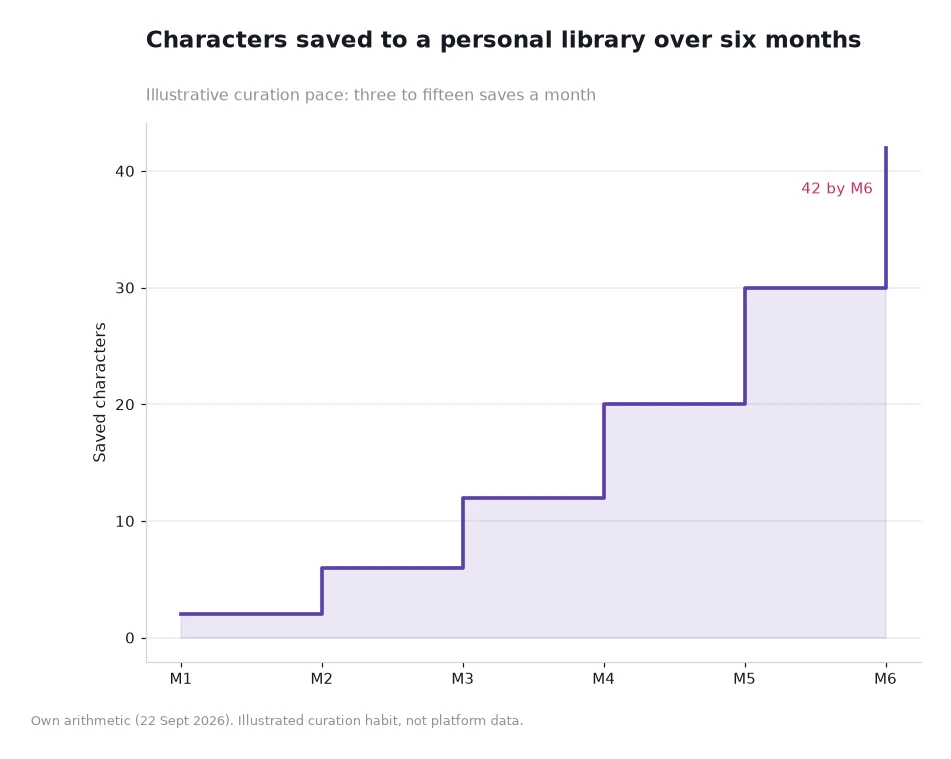
The other number worth having in view is what you are judging. A saved library at an illustrative curation pace reaches 2 characters in month one, then 6, 12, 20, 30 and 42 by the end of month six, with additions of 4 to 12 a month. Six months of use is 42 saved characters, and that is the scale of the decision ten minutes is meant to inform. It also explains why the saved-list and navigation checks earn their two minutes: a platform you cannot organise will reach the same 42 items and feel ten times as cluttered.
Making the ten minutes count
Start the clock at https://crushon.ai/ and run the blocks in order, writing one sentence per block as you go. Writing while evaluating is what turns five impressions into a verdict, and it takes seconds compared with the two-minute block it follows. At the end, score the platform out of five and move on to the next candidate, or stop, because a platform that passes all five is worth the deeper look.
Two of the blocks will need a second visit to be fair. Filters and catalogue breadth are easier to judge once you know what you are looking for, so treat the first ten minutes as a screen rather than a final answer. If the screen passes, repeat the same five checks later with a specific interest in mind; if it fails, the later visit is unnecessary, and the character search page rarely rescues a platform whose navigation and policy pages were already weak.
Frequently asked questions
Is ten minutes really long enough to judge a platform?
Long enough to screen it. Five blocks of two minutes cover navigation, filters, one real exchange, the policy pages and breadth — the questions that eliminate unsuitable options quickly. Depth needs a second visit, which is exactly what a screen is for.
Which single check is most informative?
The four-message exchange. Everything else can be described accurately on a marketing page, but how replies follow your own input is only visible by using the product for two minutes with a script you keep identical across platforms.
What should disqualify a platform immediately?
No visible route to report content, or a policy page that does not say plainly what the content is and who it depicts. Both are structural, both are cheap to state clearly, and their absence tells you what the second visit would be like.
Screen first, then commit
Set a timer, run the same five blocks on every candidate, and write your one-line verdict before opening the next tab. The point of the ten-minute test is not to replace judgement but to stop unstructured browsing from masquerading as research. If a platform survives the screen, the second visit is a genuine comparison; if not, you have saved the evening.
Data and sources: the Crushon navigation structure and the 2257 statement last updated 8 February 2025[1], read 22 Sept 2026. The six-month library progression and the six-platform comparison are illustrative arithmetic rather than platform data. For adult readers 18 years or older.